
Ashford has approved £2.85m to buy and build 41 temporary accommodation units, as households in temporary housing fell from about 290 last autumn to about 180.
Ashford Borough Council has committed £2.85m to buying and building 41 more units of its own temporary accommodation. While it does so, the number of households it is having to house temporarily has fallen sharply.
The plan was published to the council’s decisions register on 9 August, seven months after Cabinet agreed it. The money itself was signed off earlier: full Council approved and adopted the decision on 26 February.
What the money buys
The report to Cabinet on 8 January set out three separate schemes:
- £1.5m to buy a single property containing 10 one, two and three-bedroom homes, at an average of £150,000 a unit
- £150,000 for design work and a planning application for 24 modular homes on council-owned housing land
- £1.2m as match funding to acquire 7 homes through round four of the government’s Local Authority Housing Fund
Together that is 41 units. The £150,000 for the modular scheme covers only the work needed to reach the point of applying for planning permission, not the homes themselves.
The location of the 10-home property has not been disclosed. The report says negotiations were at a very early stage, that the site is currently occupied by its owners and by tenants on assured shorthold tenancies, and that vacant possession will be required. Details were withheld as commercially sensitive.
Why the council is buying
The report is blunt about the pressure. “There is a national housing crisis and this continues to impact on the Council with record numbers of households requiring temporary accommodation,” it says. “Not only is this incredibly distressing for the family or individual it also puts a significant strain on the Council’s General Fund budget.”
Temporary accommodation cost the council £3,569,225 in 2024/25. It recovered £1,034,267 of that through rent and benefit income, leaving £2,534,958 falling on the General Fund. Spending for 2025/26 was estimated at £3.92m.
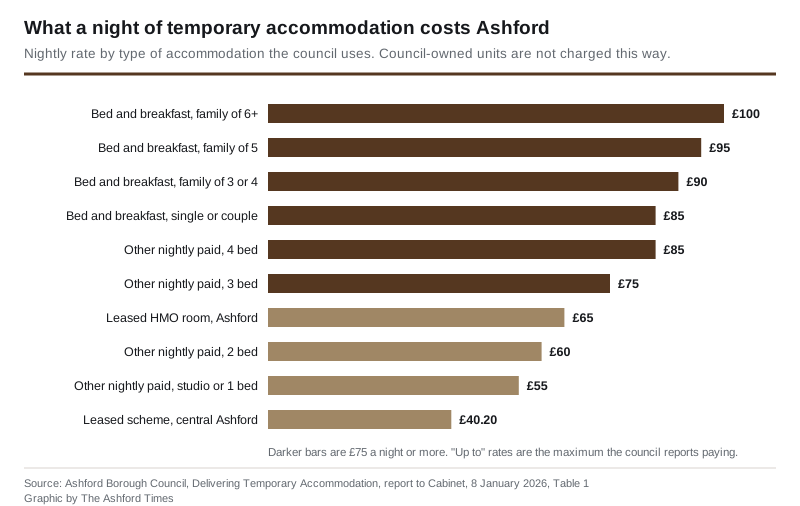
The reason council-owned units save money is the nightly rate. The report ranks the types of accommodation the council uses from most to least expensive:
- Bed and breakfast, the most expensive by a distance: up to £85 a night for a single person or a couple, up to £90 for a family of three or four, up to £95 for a family of five, and up to £100 for a family of six or more
- Other nightly paid accommodation: up to £55 a night for a studio or one bed, £60 for two beds, £75 for three, £85 for four
- A leased scheme of 35 studios and one-bed flats in central Ashford: £40.20 a night
- A 14-room HMO in Ashford on a five-year lease signed in February 2024: an average of £65 a night for a room
- Council-owned units: 52 held in the Housing Revenue Account and 65 held in the General Fund, where the report says income covers running costs
Bed and breakfast alone cost £1,452,392 in 2024/25, at an average of £79.04 a night. After an average £18.72 of income, the net cost to the council was £60.32 per night per household.
On the council’s own arithmetic, 41 additional units would avoid a maximum of £902,689 a year in bed and breakfast costs, or £749,231 once 15% voids and 2% bad debts are assumed. The report is careful to call these figures indicative, and notes they exclude management, maintenance, interest on borrowing and depreciation.
The numbers have fallen
The clearest change since January is in how many households are in temporary accommodation at all.
At a Council meeting on 26 February, Councillor Bill Barrett noted that the figure had risen to around 290 in autumn 2025. The council’s 2025/26 final outturn report, written for Cabinet in July, reports something different. The average number of cases across the year was 262, against a budget assumption of 254. Numbers “were around 180 at the time of writing this report”.
That overshoot on the average produced a £180,000 pressure on homelessness costs. The council’s General Fund still closed 2025/26 with a deficit of £183,000, having forecast a £650,000 deficit at the third quarter.
The outturn report credits “strengthened prevention activity, improved support for move-on accommodation and the more robust application of the legislative framework”. It adds: “In contrast to the last few years where temporary accommodation costs have been significantly over budget, this is a really positive outcome for 2025/26.”
Early forecasts for 2026/27 anticipate a further reduction in temporary accommodation costs.
The challenge at Council
The plan was not adopted without argument. At the February meeting Councillor Bill Barrett asked why a second scheme along the lines of Fortis House was only being considered now, rather than two years earlier. He pointed to three things: the autumn 2025 position, the Labour group’s December 2024 motion on street purchases, and the council’s knowledge of the Stodmarsh nutrient constraints.
The Leader of the Council, Councillor Noel Ovenden, who holds the finance and resources portfolio with special responsibility for housing and homelessness, replied that they were not proposing a second Fortis House. Fortis House, he said, is different because it is move-on accommodation. The council was looking at other alternatives for temporary accommodation, had a comprehensive on-street purchase programme progressing at pace, and would in the short term focus on managing and reducing temporary accommodation numbers. He said officers would give a fuller written response.
Council then approved and adopted the decision.
What it means for you
If you are threatened with homelessness, the council has a duty under Part VII of the Housing Act 1996 to find suitable temporary accommodation for qualifying households. Approach the Housing Options team as early as you can. The council’s own figures show prevention work is the single thing that has moved the numbers. The earlier a case is opened, the more options exist short of a bed and breakfast placement.
The practical significance of the council owning more of its own units is where you are housed. The report says increasing General Fund temporary accommodation “will help to ensure that homeless households can stay within the Borough”, so people can keep using the schools, workplaces and local services they already rely on. Bed and breakfast placements are the type most likely to be out of the area, and the type with shared facilities and no cooking.
The rent level does not fall on households in temporary accommodation who receive housing benefit. The council’s reason for holding units in the General Fund rather than the Housing Revenue Account is that the housing benefit limit is higher. For a one-bedroom unit it is £172.60 a week in the General Fund, against £105.19 in the HRA.
The 24 modular homes will need planning permission, so that scheme will appear on a public planning register before anything is built. Our Ashford planning news page tracks what is coming through, and Ashford house prices sets out what buying costs locally.
Sources
- Delivering Temporary Accommodation, report to Cabinet, 8 January 2026, Ashford Borough Council
- Decision record: Delivering Temporary Accommodation, published 9 August 2026
- Cabinet minutes, 8 January 2026
- Council minutes, 26 February 2026
- Final Outturn (General Fund) 2025/26, report to Cabinet, 9 July 2026
Have your say