
Ashford was to be abolished on 1 April 2028 for a 60-councillor Mid Kent Council. Ministers paused the whole plan on 7 September 2026. What was decided, and what now.
Update, 12 September 2026: this plan has been paused. On 7 September 2026 the Minister for Local Government, Devolution and Regional Growth wrote to council leaders announcing a review of the whole reorganisation programme, including the July decision that created Mid Kent Council. Councils have been told to stop work on implementing it, and the elections scheduled for May 2027 will now go ahead on existing council boundaries rather than to the new councils. No date has been set for the review to report. The article below records what was decided in July 2026 and is kept for that reason; every date and deadline in it should now be read as suspended. Our report on the pause is here: Mid Kent Council paused, Ashford votes in May 2027.
The council that will replace Ashford Borough Council has a name, a size and a deadline. It will be called Mid Kent Council, it will cover Ashford, Folkestone and Hythe and Swale, and it will have 60 councillors. Ministers set all three out in an implementation letter sent to Kent and Medway chief executives on 22 July, published by the Ministry of Housing, Communities and Local Government.
The immediate deadline is Monday 17 August. By that date the three councils must tell the ministry which council’s head of paid service should be the returning officer for the new authority’s first election, what the interim ward boundaries should be, and how parish election cycles should be aligned. The same date closes the only remaining window to change the decisions already taken: ministers will consider “any further unanimous representations”, meaning a request agreed by all three councils in the area of the new unitary, on matters “such as names and councillor numbers”.
What has been decided
The Secretary of State for Housing, Communities and Local Government, Steve Reed, wrote to Kent and Medway council leaders on 16 July confirming he would implement the four-unitary proposal put forward by Dover District Council, Swale Borough Council and Thanet District Council. His decision letter groups the borough into the council referred to in the proposal as “Mid”, alongside Folkestone and Hythe District Council and Swale Borough Council.
Kent County Council, Medway Council and the twelve district, borough and city councils are all abolished on 1 April 2028 and replaced by four authorities. The implementation letter gives their legal names and sizes:
- North Kent (Dartford, Gravesham, Medway): 81 councillors
- West Kent (Maidstone, Sevenoaks, Tonbridge and Malling, Tunbridge Wells): 84 councillors
- Mid Kent (Ashford, Folkestone and Hythe, Swale): 60 councillors
- East Kent (Canterbury, Dover, Thanet): 66 councillors
The names are legal names rather than final ones. Once a new council exists it can rename itself under section 74 of the Local Government Act 1972, which needs a council meeting called for that purpose and the support of two thirds of the members voting. Ministers also ruled out “City” in a legal name, because city status is granted by the monarch, along with the “-ern” suffix and dashes.
Sixty councillors instead of 124
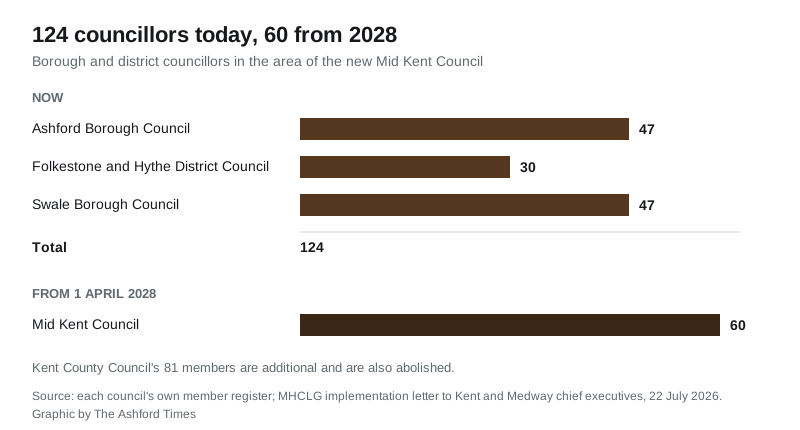
Mid Kent Council’s 60 seats replace the borough and district councillors currently elected across the three areas. Ashford Borough Council has 47 members, Folkestone and Hythe District Council has 30 and Swale Borough Council has 47, a total of 124. Kent County Council’s 81 members, six of whose divisions cover Ashford borough, go as well when the county council is abolished.
Interim wards for the first election have not been drawn yet. That is one of the things councils must submit by 17 August, and the letter says they “can be based on existing wards, divisions and parish boundaries” but not polling districts. The Local Government Boundary Commission for England will run a full electoral review of all the new councils before the following election.
The dates that matter
- 17 August 2026: councils return returning officers, interim warding and parish election information, and any unanimous representations on the name or councillor numbers.
- September 2026: the ministry expects to share a draft Structural Changes Order with the councils.
- 2027: the Order is scrutinised by the Joint Committee on Statutory Instruments and the Lords Secondary Legislation Scrutiny Committee, debated in committee in both Houses and put to approval motions. Ministers anticipate it will be made and come into force during 2027.
- May 2027: elections to the new councils. These replace any local elections scheduled for that month, and sitting councillors have their terms extended to that point.
- 1 April 2028: Ashford Borough Council and Kent County Council cease to exist and Mid Kent Council takes on every local government service in the area.
Councillors elected in May 2027 spend most of their first year on a “shadow” council with preparatory powers only, setting the first budget and plans before the new authority takes over services.
Who runs the transition
There will be one implementation team for the whole county, led by Kent County Council’s head of paid service, with four deputies, one drawn from a district or borough within each new area. For Mid Kent that deputy is to be “agreed locally” between Ashford, Folkestone and Hythe and Swale. Each new council also gets a joint committee: Mid Kent’s has 12 members, six from the three districts and six from the county council. The ministry has appointed Theresa Grant as the area’s sector advisor.
The government has attached money to the work. Each new unitary gets £900,000 in transition funding, £3.6 million across Kent and Medway, paid by Section 31 grant to the council employing the deputy implementation lead unless the councils agree otherwise. On top of that, up to £150,000 per new council is available for leadership capacity in children’s services, adult social care and public health, drawn from a £63 million national capacity fund. The letter is specific that short term consultancy “is unlikely to offer good value for money” and that spending should leave a lasting legacy.
Once the Order is in force, ministers expect to issue a direction under section 24 of the Local Government and Public Involvement in Health Act. That will require Ashford Borough Council and its neighbours to get the shadow council’s consent before signing certain contracts or disposing of certain assets, so that decisions taken in the final months do not saddle the new authority.
Why this option
Mr Reed’s letter sets out his reasoning. He rejected the single-unitary proposal for Kent and Medway outright, citing a population “at over 1.9 million, far exceeding the 500,000 guiding principle” and describing the federated model behind it as untested. He accepted that two of his four chosen councils fall below 500,000 residents, and answered that directly: “The 500,000 figure has, however, always remained a guiding principle, not a fixed threshold.”
He judged the chosen option strongest on housing delivery, alignment with economic areas and existing public sector boundaries, and on neighbourhood governance through area committees. He described Mid Kent as combining “fast growing urban centres with rural and coastal assets and strong connectivity”. The letter also flags an unresolved issue, the future handling of responsibilities for unaccompanied asylum-seeking children, which it says will be addressed in the implementation legislation.
This was not Ashford’s preferred outcome. Responding on the council’s own news pages on 17 July, the leader of Ashford Borough Council, Cllr Noel Ovenden, said: “While this is not the option Ashford Borough Council identified as its preferred approach, we respect the Government’s decision and recognise the importance of moving forward together with clarity and purpose.” Ashford councillors had backed a different model, option 4d, in November, on the basis that minor boundary changes were acceptable.
What it means for you
Nothing changes for the next 19 months. Ashford Borough Council keeps collecting your bins, running housing and deciding planning applications until 31 March 2028, and Kent County Council keeps running roads, schools and social care. The implementation letter is explicit that existing councils “remain responsible for services in your areas until they are abolished”.
The first thing you will actually do differently is vote. There is no separate borough election in May 2027 as the cycle would normally provide; instead you elect members of Mid Kent Council, in wards that have not been drawn yet. Whoever you elect will not run services for almost a year after that.
After April 2028, everything goes through one council: bins and planning and housing, but also the county responsibilities of highways, libraries, schools and adult and children’s social care. That is the practical change, and it is why the size of the new council matters. Sixty members will cover a population currently served by 124 borough and district councillors plus a share of Kent’s 81.
The documents published so far do not say anything about council tax levels in the new area. Later legislation is expected to deal with pensions, housing revenue accounts and ceremonial matters, and the ministry says it will consult councils on it.
We will follow the Structural Changes Order when the draft appears in September, including the ward boundaries proposed for Ashford. In the meantime, see our pages on planning in Ashford, roadworks and travel and house prices across the borough.
Have your say